
The cattle industry is looking to Florida to keep up with the demand for livestock as a result of the nation’s worst drought since 1956. The U.S. Department of Agriculture estimated a record 54 percent of pasture and rangeland west of the Mississippi was in poor and very poor condition last summer. As a result, one-third of the nation’s counties across 29 states were considered federal disaster areas.
According to industry experts at the 2013 Cattle Industry and National Cattlemen’s Beef Association Trade Show in Tampa, calf prices at auction are at record levels with a very positive outlook for the Florida cow-calf industry. Central Florida has more than 7 million cows. The University of Florida assessed that producers with profitable cattle enterprises have generally had low land costs, used flexible marketing strategies, and been willing to use new technology for successful breeding, as well as birthing and raising the calves.
Drought destroyed about a third of the corn crop last year in the U.S. Consequentially feed prices skyrocketed. Corn is manna to herds that thrive through frigid winters. Even with elevated calf prices, ranchers are faced with higher break even points, which have forced them to reduce their herd size. It will take at least six years of abundant conditions to bring their herds back to pre-drought numbers. Ranches in Florida supply calves to these grazing operations, and to feed lots for fattening in grain producing states. Local breeders have prospered from the increased demand of calves not available elsewhere. Many farms in the south have the added benefit of growing their own Bahia grass, rye and Bermuda to feed their stock.
Large parcels and lower acreage prices are trending in the real estate market in Marion County. The vicinity is on the doorsteps of becoming the most prominent beef producing region in the state with the proposed development of Adena Springs Ranch which should boost several economic niche markets, including fence building. New job opportunities will arise on farms and at the processing plant. As well, local cattle breeders will no longer need to ship livestock out of state. The St. Johns River Water Management District currently has the Adena Springs Ranch’s required water consumptive use permit application under stringent review.
Florida’s cattle industry is one of the oldest and largest in the nation. Florida adopted a ‘Green Belt’ law in 1959 which taxes land according to its agricultural use-value rather than its value for potential development. An agricultural land classification results in a lower property assessment. Without such protection, a farmer’s taxes could be raised to the point where it would no longer be economically feasible for that farmer to continue the agricultural use.
If you are considering buying land for agriculture of all types, now is the time to weigh your options. At today’s prices, land appears to be a very good investment. Compare interest rates and CD returns. We are seeing a lot of interest from foreign investors in Marion County.
Admira-bull contributions to Florida
Well in advance of conjured movie scenes of cattle drives and old west hard boots, North America’s first cattle and first cowboys lived in Florida in missions and colonies. Conquistadors were riding Spanish Barbs on the beaches and into the thickets of Florida’s forestland. The first private ranch began operation in 1605. Cattle shipped from Spain to feed military garrisons flourished on emergent range grasses in Florida’s rich soils.
Juan Ponce de Leon imported oranges and long-horned Andalusian cattle to aid in his quest to find gold. Exactly five hundred springtimes since Ponce de Leon landed in “La Florida” and found the peninsula in bountiful bloom, Florida’s Department of Agriculture and Agriculture Commissioner Adam Putnam is commemorating the explorer’s contributions to the state. The statewide traveling exhibit is called “Florida Agriculture: Then and Now.” The commissioner
is also hosting several well rounded University panel discussions on farming and Florida’s cattle industry.
According to Putnam’s historians and tax collector records, Florida was home to 34 ranches and 20,000 head of cattle by 1700. The largest of the ranches, La Chua, was located to our north near present-day Gainesville.
British invasions of Spanish missions and ranches abandoned the cattle to feral conditions. These extremely hardy, heat and disease resistant bovines survived to become the foundation of Florida’s breeding industry – the original ‘Cracker Cattle.’
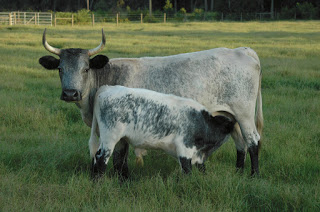
The distinctive horns of the Florida Cracker Cattle tend to point up rather than out. Ranchers cross bred them with European stock which were less adaptable to the sub-tropical climate. The first descendants of the weather tolerant Brahman breed, or Bos indicus (known as Zebu, the sacred cattle of India) was also introduced in the mid 1800’s.
Florida was the leading supplier of beef to both the confederate and union troops during the Civil War. As a result of Florida’s cattle industry, it was one of the first states to establish an economy after the war. Florida became the nation’s leading cattle exporter from 1868 to 1878, when ranchers received millions of dollars in gold doubloons for over 1.6 million cattle exported to Cuba from ports in Tampa.
-Julie K.Castro
Written for The Farm Report and in two pieces for realocala.blogspot.com
 REAL ESTATE & MARKETING