

In the southeasterly reaches of Marion County lies a freshwater basin encompassing 9,600 acres with 38 miles of shoreline. Lake Weir along with its sister Little Lake Weir has a storied past from its discovery by natives to once being the hideout of a mob boss that boasted about chasing a huge alligator that the local townsfolk called “Joe.” Today, the lake is one of the finest recreational lakes in Florida and offers lodging and dining overlooking the water where birds and an occasional seaplane take wing.
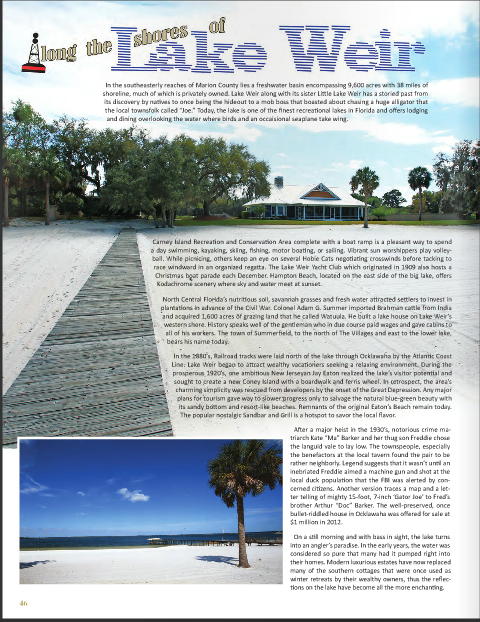
Carney Island Recreation and Conservation Area complete with a boat ramp is a pleasant way to spend a day swimming, kayaking, skiing, fishing, motor boating, or sailing. Vibrant sun worshippers enjoy a game of volleyball, while picnic-goers keep an eye on several Hobie Cats negotiating crosswinds before tacking to race windward in an organized regatta. The Lake Weir Yacht Club, which originated in 1909, hosts the annual Christmas boat parade. On the east side of the big lake, Hampton Beach offers Kodachrome scenery where sky and water meet at sunset.
North Central Florida’s nutritious soil, savannah grasses and fresh water attracted settlers to invest in plantations in advance of the Civil War. Colonel Adam G. Summer imported Brahman cattle from India and acquired 1,600 acres of grazing land that he called Watuula. He built a lake house on Lake Weir’s western shore. History speaks well of the gentleman who in due course paid wages and gave cabins to all of his workers. The town of Summerfield, to the north of The Villages and east to the lower lake, bears his name today.
In the 1880’s, Railroad tracks were laid north of the lake through Ocklawaha by the Atlantic Coast Line. Lake Weir began to attract wealthy vacationers seeking a relaxing environment. During the prosperous 1920’s, one ambitious New Jerseyan Jay Eaton realized the lake’s visitor potential and sought to create a new Coney Island with a boardwalk and ferris wheel. In retrospect, the area’s charming simplicity was rescued from developers by the onset of the Great Depression. Any major plans for tourism gave way to slower progress only to salvage the natural blue-green beauty with its sandy bottom and resort-like beaches. Remnants of the original Eaton’s Beach remain today. The popular nostalgic Sandbar and Grill is a hotspot to savor the local flavor.
After a major heist in the 1930’s, notorious crime matriarch Kate “Ma” Barker and her thug son Freddie chose the languid vale to lay low. The townspeople, especially the benefactors at the local tavern found the pair to be rather neighborly. Legend suggests that it wasn’t until an inebriated Freddie aimed a machine gun and shot at the local duck population that the FBI was alerted by concerned citizens. Another version traces a map and a letter telling of mighty 15-foot, 7-inch ‘Gator Joe’ to Fred’s brother Arthur “Doc” Barker. The well-preserved, once bullet-riddled house in Ocklawaha was offered for sale at $1 million in 2012 and was later ferried across the lake to its current location.
On a still morning and with bass in sight, dew drifts over the angler’s paradise. In the early years, the water was considered so pure that many had it pumped right into their homes. Modern luxurious estates have now replaced many of the southern cottages that were once used as winter retreats by their wealthy owners, thus the reflections on the lake have become all the more enchanting.
Julie K Castro
-Julie K. Castro
 REAL ESTATE & MARKETING