

While other states are experiencing cultural, economic and land use barriers, thankfully the State of Florida has recognized the importance of the equine industry here in Marion County. In a study released earlier this year, Ocala Marion County Chamber and Economic Partnership with the aid of Horse Shows in the Sun estimated that the horse business has had an annual $2.62 billion effect on the county’s economy.
Horse competitions held at the various facilities along with thoroughbred auctions held at the Ocala Breeders’ Sales (OBS) complex attract visitors who, in turn spend quite a bit of money on lodging, dining, and transportation. Part-time residents will often rent before buying a home or farm. The season sets up for numerous equestrian social functions, oftentimes charities, which in turn supports the party vendors.
Commercial businesses directly relating to horse husbandry include the feed and supply stores, stabling facilities, even clothing retailers, dry cleaners and grocery stores. Add in the day-to-day care and exercise, manure removal, as well as veterinarian and farrier services, it is roughly estimated that over 19,000 people are employed in full or part-time positons directly correlating to the equine industry. If the value of volunteer labor were included, the sums would be even higher.
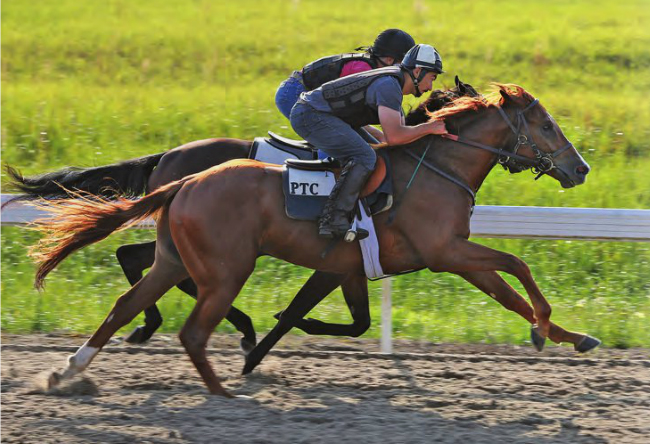 The agri-business of horse racing has had a major impact on Florida and Marion County in particular. In 2014, the thoroughbred auction house at OBS processed receipts exceeding $142 million, a 20% increase over the 2013 gross sales. Buyers attended from all over America and at least 22 countries. Last year, two colts – one sired by Giants Causeway and one by Tapit, were purchased for $1.6 million; both equaling the mark for the highest price paid for a two year old in training in North America. Another, a son of Malibu Moon fetched $1.3 million. In 2015, Ocala’s own Live Oak Plantation went to $1.4-million in March to purchase a colt by Bernardini, a ¾ brother to their Grade One winning color bearer To Honor and Serve.
The Spring Sale, held each year in April at OBS, has produced numerous champions over the years including grass specialist Kitten’s Joy; and Kentucky Derby winners Lil E. Tee, Silver Charm and I’ll Have Another. This spring, a daughter of Tapit was hammered down for $1,900,000, thus establishing a new milestone.
To better gauge this economic climb which continued through the June Sale in the midst of the buzz over American Pharoah sweeping racing’s Triple Crown, the sale hit its best mark with a son of Candy Ride (Arg), purchased for a record $680,000. On prior days, two other juvenile colts equaled the previous record of $575,000 – one, a son of Scat Daddy and the other sired by Into Mischief. The overall numbers in June had never been better.
Ocala is one of four global centers with a high concentration of horses and farms. The others, Newmarket in England, Chantilly in France, and Lexington, Kentucky have the advantage of a fully functioning pari-mutuel race course that pulls in tourism.
Significantly, Marion County has 40% of all sanctioned training tracks in America. Although registered Florida-breds equal 9.4% of the entire North Amercian foal crop – second only to Kentucky at 32.5%, Marion County is recognized as a pivotal hub for breaking and training young thoroughbreds. Ten of this year’s Kentucky Derby starters were broken and trained locally, winner American Pharoah included.
Equibase has on its register: 84 Marion County sanctioned ovals with clockers that can turn in recorded workouts – a requirement for a horse to start in a pari-mutual race. Numerous trainers prep their horses here and ship four-and-a-half hours south to Gulfstream Park in Hallandale and to Tampa Bay Downs, about two hours away.
Horsemen enjoy uninterrupted year-round riding and training. One winter here, free of shoveling snow, scraping windshields and breaking ice on water buckets, and they are hooked.
Marion County at 1,652 square miles, is made up of four quadrants divided by Highway 40 and Interstate 75. Within its sprawling borders, the county is less congested and 40% less populated than Florida’s county average. It’s roughly estimated that there are 209 people per square mile. By comparison, Palm Beach County, where the city of Wellington is located, houses 670 people per square mile. On over 1,200 farms, Ocala’s horse population exceeds the human population two-to-one. As home to 50 known breeds of horses and ponies – more than any other county in the United States, Ocala Marion County’s christening of Horse Capital of the World ® stands to reason.
The Marjorie Harris Carr Cross Florida Greenway traverses 110 miles from the Gulf of Mexico to the St. John’s River. Along the way, Florida’s flourishing natural habitat is etched with the remnants of a defunct barge canal project, and the current trail system which is enhanced by designated recreation areas and trailheads.
In ten years since its groundbreaking, the Florida Horse Park has hosted local, national, and international competitions. The 500 acre equestrian facility is seated on a portion of the Greenway and is adjacent to Cashel Stud Farm. Propelled by the Florida Agriculture Center and Horse Park Authority, the park hired Olympian David O’Connor to design its first cross country course and held its first international 3-Day Event in 2006. The Festival of the Horse International is an advanced level competition; granted ranking in accordance with the Concours Complet International ratings under the rules of the governing body, International Federation for Equestrian Sports (FEI).
In 2008, the park was awarded $1 million by the State of Florida Office of Tourism, Trade & Economic Development to fund basic infrastructure. The show horse facility has exciting expansion plans and has installed a state-of-the-art covered arena. A variety of dog and horse events are held under the new roof including dressage, jumping, rodeo and team roping, plus registry specific shows such as for the American Quarter Horse Association.
Nearby, Cactus Jack Trail Rides is Ocala’s only guided horse rental service through the Florida Horse Park and the Greenway.
Across town, the HITS show for the hunter and jumper competitors will open its 2016 season with a newly constructed Hunter Stadium featuring the $100,000 USHJA International Hunter Derby. Big sponsorships will again lure great talent to the
$1 Million Grand Prix – always a crowd pleaser. The series will run from January 19 until March 28.
Circle the date also for February 25 – 28. Live Oak International sets the stage for another Victorian-style in-harness competition, presenting the highest level of coachmanship which brings with it all of the pomp and athleticism of this equine discipline. In one of the most posh countryside settings in all of Ocala, social tailgating and gourmet buffets are served overlooking the field ceremonies and the CSI** Live Oak International Grand Prix.
 REAL ESTATE & MARKETING